
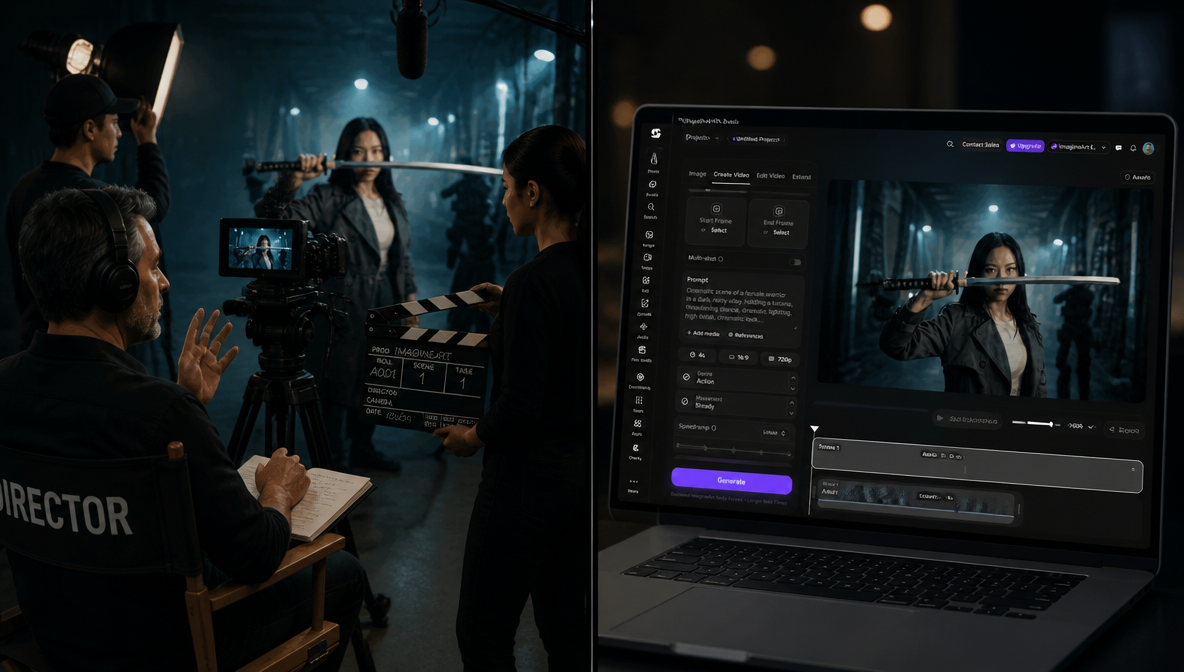
Video Production Studios in 2026: The Complete Comparison of Traditional Production vs. AI-Powered Creative Agencies
Estimated reading time: 10 minutes
Key Takeaways
- In 2026, video production is divided between traditional studios and AI-powered agencies.
- Traditional studios rely on physical crews and manual editing, offering high-quality cinematic work but requiring long timelines.
- AI creative agencies leverage automation and AI tools to deliver personalized, scalable content rapidly.
- Choose your partner based on your need for speed, scale, and personalization.
Table of contents
- Defining the Two Models – What Are Video Production Studios in 2026?
- The 7-Point Comparison – Traditional vs. AI Video Production
- Inside AI-Powered Video Production Studios – The 2026 Workflow
- Service Capabilities – What AI Video Production Studios Deliver in 2026
- Geographic Comparison – Global Traditional Hubs vs. AI Creative Agency Philippines
- Implementation – Choosing Between Traditional and AI Video Production Studios in 2026
- The Future Outlook – Video Production Studios in 2026 and Beyond
Video Production Studios in 2026 are no longer defined solely by physical soundstages and manual editing suites, but by a fundamental split between legacy production models and AI creative agencies.
If you are a brand leader today, you face a clear choice. You can hire traditional studios that rely on physical film crews, on-location shoots, and hand-edited timelines. Or you can partner with an AI creative agency that uses generative AI, automation, and data analytics to plan, create, and optimize content at machine speed.
This guide compares both models side by side. You will learn how AI video production works, what services modern studios offer, and why geographic boundaries no longer limit creative quality.
The Bottom Line: The right partner depends on your need for speed, scale, and personalization. Traditional studios offer artisanal craft. AI-powered studios offer scalable video content strategies that grow with your business.
Defining the Two Models – What Are Video Production Studios in 2026?
Traditional Video Production Studios
Traditional studios operate on human-led, manual workflows. They rely on:
- Physical film crews and camera operators
- On-location shoots with lighting and set builds
- Hand-edited timelines in software like Premiere or Final Cut
- Linear versioning processes (one edit at a time)
This model produces high-quality cinematic work. However, it requires weeks or months to deliver campaigns. Changes cost extra money. Scaling to hundreds of video versions is nearly impossible.
AI Creative Agency: The New Standard
An AI creative agency is a marketing and production agency that builds its services around artificial intelligence. It uses tools like generative AI, automation, and data analytics to plan, create, distribute, and optimize creative content much faster and more precisely than traditional agencies.
These agencies combine human creative direction with machine efficiency. They use predictive models, automated workflows, and synthetic media to deliver personalized content at scale.
A generative AI marketing agency represents a specialized subset. These firms focus on synthetic media, automated asset generation, and AI-powered creative production that replaces expensive physical shoots with virtual production.
Key Difference: Traditional studios rent cameras. AI studios build content engines.
Sources: FunctionFox, Digital Agency Network, Darkroom Agency
The 7-Point Comparison – Traditional vs. AI Video Production
1. Core Operating Engine
Traditional: Human-only workflows. Every cut, color grade, and caption requires manual labor.
AI Creative Agency: Human + AI co-creation. Automated workflows handle repetitive tasks like resizing, captioning, and basic editing. Humans focus on strategy, high-level creative direction, and quality control.
2. Production Speed & Volume
Traditional: Campaigns take weeks to months. You get one or two hero videos and a few cut-downs.
AI-Powered Studios: Deliver content 5–10x faster. They produce large volumes in hours to days through automation and batch generation. This means you can test dozens of creative variations instead of betting everything on one ad.
3. Personalization Capabilities
Traditional: Limited to broad demographic segments. One video for “women aged 25-40.”
AI Studios: Offer 1:1 hyper-personalization at scale. They use behavior and first-party data to tailor creatives to micro-segments or individuals. Imagine a video where the spokesperson mentions the viewer by name and references their specific pain points—automatically.
4. Data Utilization
Traditional: Uses reporting and basic targeting. You get a PDF report after the campaign ends.
AI Studios: Use predictive models, real-time optimization, and full-funnel attribution. They adjust creative elements, bids, and audiences while the campaign runs.
5. Production Methodology
Traditional: Relies on physical shoots, manual editing, and hand-drawn design.
AI Studios: Utilize synthetic media, AI design, automated video and copy generation, and virtual shoots. They create realistic environments and presenters without leaving the office.
6. Cost Structure
Traditional: Heavy labor and production overhead. Location fees, crew rates, and equipment rentals add up fast.
AI Studios: Offer more efficient production. Budgets shift from production costs to media spend and experimentation. You get more assets for less money.
7. Scalability
Traditional: Scales linearly with crew size. More videos means more editors working more hours.
AI Studios: Achieve scalable video content strategies through template-driven generation and workflow automation. One brief can yield hundreds of on-brand variations instantly.
Sources: FunctionFox, Darkroom Agency, The Keenfolks, YouTube, SuperSide Blog, AI Media Group
Inside AI-Powered Video Production Studios – The 2026 Workflow
Unlike traditional studios that start with storyboards and casting calls, AI creative agencies follow a data-first workflow. Here is how they work:
Step 1: Discovery & Data Intake
The agency ingests your brand assets, guidelines, past campaigns, CRM data, and web analytics. They build a data- and brand-trained baseline that ensures all future content matches your voice and visual identity.
Step 2: Strategy & AI Architecture
Teams define audiences, customer journeys, and KPIs. Then they select the right AI tools:
- LLMs for copywriting and scripting
- Image and video generators for visual assets
- Analytics platforms for tracking
They plan API integrations with your CRM, CDP, and ad platforms to enable seamless data flow.
Step 3: Creative System Design
Instead of creating one-off assets, AI studios build content building blocks. They develop:
- Prompt libraries for consistent visual styles
- Design systems and templates
- Messaging angles and hooks
The AI then recombines these blocks at scale to generate unlimited variations.
Step 4: AI-Powered Production
This is where the magic happens. Agencies use tools like:
- Midjourney for style frames and concept art
- Runway for generative motion and video editing
- Sora for high-end text-to-video production
Human creatives refine the AI output, ensuring brand standards and emotional resonance.
Step 5: Deployment & Automation
Content flows automatically into your marketing funnels—ads, email, landing pages, and social media. The agency sets up automations for content variation,