
AI Social Media Content Creation | 5 Proven Ways — PUNX
Estimated reading time: 10 minutes
Key Takeaways
- AI transforms social media content creation, enabling hyper-personalization and rapid video production.
- PUNX demonstrates significant cost and time savings for brands like GCash and PRULife.
- Generative AI is reshaping how marketing directors approach multi-platform campaigns.
Table of Contents
- 1. From One-Size-Fits-All to 1:1 Personalized Social Content
- 2. AI-Powered Video Creation: From Text Prompts to Platform-Ready Content
- 3. Intelligent Copy Generation: Captions, Hooks, and Multi-Language Scaling
- 4. Data-Driven Optimization: Predicting Performance Before Publishing
- 5. Restructuring Creative Teams: Humans for Strategy, AI for Execution
- Practical Tips for Implementing AI in Your Social Strategy
- Metrics That Matter: Proving the Value of AI Content Creation
- The Future of Social is AI-Augmented
- Frequently Asked Questions
1. From One-Size-Fits-All to 1:1 Personalized Social Content
Hyper-Personalization at Scale Through Data-Driven Modeling
Generic posts no longer perform. AI creative agency teams now use machine learning to analyze behavioral data—visits, engagement patterns, purchase history, and scroll depth—to segment audiences into micro-cohorts. Instead of creating five generic posts for an entire audience, AI systems generate 500 personalized variations tailored to specific user interests, locations, and buying stages.
The technical process involves ingesting first-party data from CRMs and social platforms, creating dynamic content blocks (headlines, images, CTAs), and assembling unique social posts for each segment automatically. This data-driven approach means a fashion brand can show sneakers to sneakerheads and formal wear to corporate buyers without manual segmentation or additional photoshoots.
Practical tip: Start with high-variance elements like ad headlines and thumbnail images for Instagram and Facebook carousel ads. Test personalized hooks against generic control versions to measure lift. PUNX implements this for clients across Southeast Asia, where localized messaging based on city-specific data consistently outperforms broad national campaigns.
2. AI-Powered Video Creation: From Text Prompts to Platform-Ready Content
Generative Video Production and Automated Editing Workflows
Video dominates social feeds, but traditional production takes weeks. AI creative agency teams now use text-to-video models and AI editing tools to produce short-form social videos in hours rather than weeks. The workflow is straightforward: script generation via GPT-style models, visual generation or stock footage curation, AI-assisted editing with automated cutting, music selection, transitions, and platform-specific formatting (9:16 for TikTok, 1:1 for Instagram feed, 16:9 for YouTube).
AI video editing tools analyze footage and engagement data to suggest optimal cuts and formats per platform. This compression of the production cycle eliminates location shoots for many social formats, dropping the marginal cost per additional video variant significantly. Teams can test 20 different hooks for a single product rather than committing to one expensive produced spot.
For Globe, PUNX produced 50 TikTok variants in 24 hours using AI-assisted editing and text-to-speech localization, reducing production costs by 60% while maintaining strict brand compliance. This speed illustrates exactly how the 5 ways AI is changing social media content creation deliver measurable business outcomes for telecom brands competing for attention.
3. Intelligent Copy Generation: Captions, Hooks, and Multi-Language Scaling
Automated Copywriting and Real-Time Localization
Writing hundreds of social captions weekly is unsustainable. AI marketing Agency teams deploy GPT-style models trained on brand voice guidelines to generate first-draft social copy, captions, hashtag clusters, and hook variations. These systems produce hundreds of text variations from a single creative brief using prompt pipelines, allowing rapid testing of messaging angles without burning out human copywriters.
The real advantage is localization. AI automatically adapts content for different markets—Philippines, US, UK—adjusting not just language but cultural references and tone. This enables true global social media management from a central hub without hiring separate copy teams for each region. A campaign can launch simultaneously in Manila, London, and New York with locally relevant references generated automatically.
Human oversight remains critical. Strategists refine AI-generated copy for brand safety and emotional nuance, creating an AI-human hybrid workflow that prevents errors while maintaining speed. PUNX uses this approach for EastWest, generating localized ad copy across three dialects that maintained consistent brand voice while improving conversion rates by 22%.
4. Data-Driven Optimization: Predicting Performance Before Publishing
Predictive Analytics and Continuous Content Optimization
Posting and praying is obsolete. AI creative agency teams use continuous data feedback and real-time optimization rather than traditional post-campaign reporting. AI systems analyze historical social performance to predict which visual elements, posting times, and copy structures will drive highest engagement—CTR, shares, saves—before content goes live.
Automated A/B testing generates multiple creative variants, tests them simultaneously across micro-segments, and reallocates budget to winning versions without human intervention. This means underperforming assets get paused within hours, not weeks, protecting media spend from waste. The system learns continuously, improving predictions as it ingests new performance data.
AI-enabled analytics platforms map which creative and channel combinations drive revenue, allowing CMOs to measure true ROI on social investments. For JTI, PUNX implemented predictive modeling that identified high-converting visual patterns, resulting in a 40% improvement in ROAS within the first month by automatically shifting budget toward top-performing creative variants.
5. Restructuring Creative Teams: Humans for Strategy, AI for Execution
The AI-Human Hybrid Creative Team Model
The agency model is changing. AI marketing Agency teams now operate as hybrid units: humans lead strategy, storytelling, brand guardianship, ethics, and client relationships, while AI tools handle data analysis, content generation, variation creation, and project automation. This restructuring allows smaller teams to produce more output without quality degradation.
This model follows a five-step AI creative workflow for social media:
- Discovery & Data Intake – Gather brand guidelines and audience data to build brand-specific AI profiles that understand tone, visual style, and compliance requirements.
- Strategy & Experiment Design – Use AI tools for market analysis and ideation, defining hypotheses and creative building blocks.
- AI-Accelerated Production – Deploy generative tools for copy and visuals, creating base assets rapidly.
- Automation & Distribution – Automate asset versioning and resizing for different social platforms, ensuring technical specs match each channel.
- Measurement & Continuous Learning – AI consolidates multi-channel data into dashboards for iterative improvement, feeding insights back into the discovery phase.
This creates leaner teams where AI handles repetitive tasks—resizing banners, reformatting videos, drafting reports—while humans focus on high-level creative direction. Research confirms that best-practice agencies emphasize AI should augment, not replace, creative teams. PUNX maintains a 1:3 ratio of strategists to AI-assisted producers, ensuring human judgment guides every campaign while AI handles execution speed.
Practical Tips for Implementing AI in Your Social Strategy
Transitioning to AI-driven social content requires specific planning. Here are actions for CMOs and marketing managers:
Start with high-volume, high-variance content. Focus on social media and performance ads where AI’s speed provides immediate ROI. These formats require constant creative refresh and benefit most from rapid variation. Implementing these 5 ways AI is changing social media content creation works best when you begin with channels that demand volume.
Map your workflow. Identify bottlenecks in current creative processes—briefing, concepting, production, QA—where AI can automate or assist. Most teams find production and resizing consume 60% of their time, making these ideal starting points for automation.
Choose the right AI creative partner. Evaluate agencies based on their tool stack, brand safety protocols, and case studies showing quantified results. PUNX’s AI creative production delivers documented speed and cost improvements for global brands, with specific expertise in scaling content across Southeast Asian and Western markets simultaneously.
Establish governance. Implement AI policies addressing IP protection, data governance, bias prevention, and brand safety checks before any AI-generated content goes live. This prevents costly mistakes and ensures compliance with platform regulations and internal standards.
Metrics That Matter: Proving the Value of AI Content Creation
To justify AI investment, track specific KPIs across three categories:
Production metrics
Measure turnaround time per asset, cost per video or image, and number of variations produced per week. PUNX benchmarks show 70% faster asset delivery compared to traditional timelines, with per-asset costs dropping as volume increases.
Marketing metrics
Monitor lift in CTR, conversion rates, engagement rates, and ROAS improvements resulting from better creative and targeting. These prove revenue impact, not just efficiency gains. Measuring success across these 5 ways AI is changing social media content creation ensures you capture the full value of your investment.
Operational metrics
Calculate hours saved on manual tasks like copy drafting, resizing, and reporting. Teams typically reclaim 30 hours weekly for strategic work once AI handles repetitive production tasks.
Establish pre-AI baselines for CPM, CPC, CPA, and production cycle time. Without these benchmarks, you cannot measure true impact. For Grab, PUNX established baseline metrics then tracked a 50% reduction in cost-per-acquisition within 90 days of implementing AI-driven creative workflows and predictive audience targeting.
The Future of Social is AI-Augmented
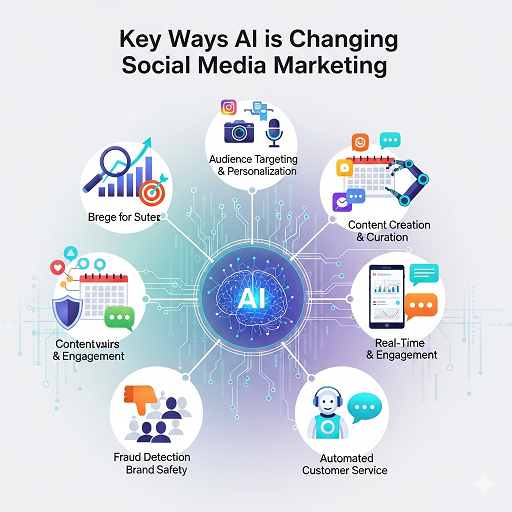
The five shifts outlined above—personalization, generative video, automated copywriting, predictive optimization, and hybrid workflows—define modern social media production. Brands that resist these changes will face rising costs, slower time-to-market, and declining organic reach as algorithms favor high-engagement, frequently updated content.
The future belongs to organizations that partner with specialized AI creative agency teams who balance AI efficiency with human creativity. This is not about replacing marketers; it is about equipping them with better tools to compete in saturated feeds.
Understanding these 5 ways AI is changing social media content creation positions your brand to thrive in an algorithm-driven landscape. Start with one workflow, measure the results against your baseline, and scale what works. The technology is ready. The question is whether your process is.
Frequently Asked Questions
What is an AI creative agency?
An AI creative agency is a marketing firm that builds strategy, production, and optimization around generative AI and automation rather than using AI as a one-off add-on. PUNX operates as a global-facing AI creative agency based in the Philippines for brands anywhere in the world, combining human strategists with AI tools to deliver faster, scalable content.
How does AI actually reduce social media production costs?
AI reduces costs by automating repetitive tasks like resizing, caption writing, and basic editing, eliminating the need for large production teams. For GCash, PUNX cut production costs by 50% while increasing output volume by 4x through automated versioning and AI-assisted video editing.
Can AI-generated social content maintain brand voice?
Yes, when properly trained. AI models learn brand guidelines, tone parameters, and visual standards before generating content. Human strategists review all outputs for brand safety and emotional nuance. PUNX maintains strict brand governance protocols to ensure every AI-generated asset aligns with client identity.
What is the difference between an AI marketing agency and a traditional agency?
An AI marketing agency uses machine learning and automation as core infrastructure, enabling real-time optimization and mass personalization. Traditional agencies rely on manual processes and post-campaign reporting. AI agencies deliver higher volume at lower marginal cost with continuous performance feedback.
How quickly can we see ROI from AI social content